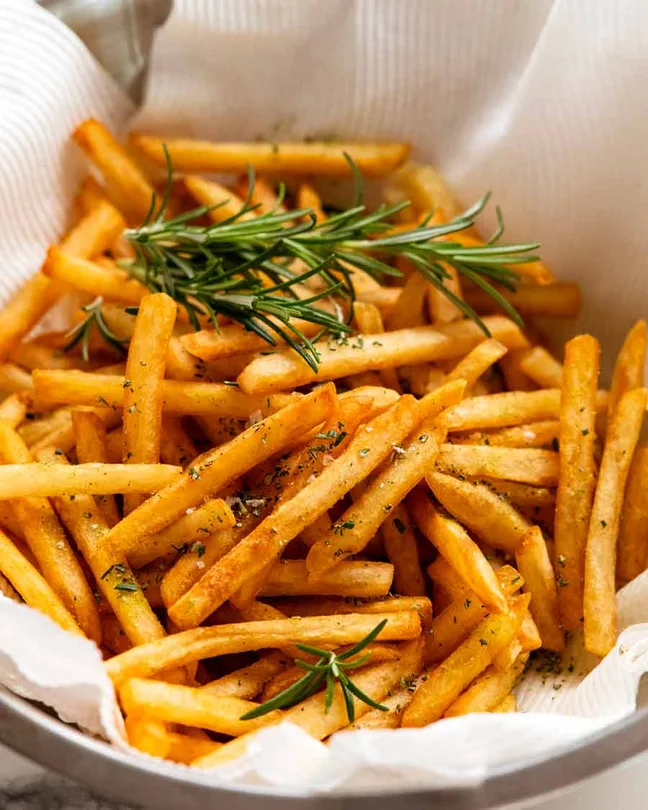
Perfect Crispy French fries
Finally, here it is – The perfect french fries recipe! Based on a ground-breaking method from the legendary Kenji López-Alt’s The Food Lab, these hot chips are so crispy they stay that way even after they’ve gone cold. It’s rare to find fries this good even at up-market bistros! Bowl of freshly made French fries with rosemary salt No false promises – these french fries really stay crisp! There’s nothing more deflating than going to all the effort of making your own fries from scratch, only to find they start losing crispiness before they even hit the table. Which is what happens if you use the standard way of cooking homemade fries – soaking in water followed by a double fry. Well, it’s taken me years but with the help of the impressively thorough french fry research documented in Kenji López-Alt’s The Food Lab, Chef JB and I have finally nailed down the recipe for the perfect homemade french fries. Fluffy on the inside, crispy on the outside – and stays crispy well beyond the time it takes to eat the fries and, say, a big juicy Cheeseburger. The ideal french fry! Really, the crispiness endurance is insane. These french fries are still crispy even after they’ve gone cold! Heads up – this post is quite long because I cover the “why” and also want to arm French fry first-timers with the confidence to make this recipe. So if you’re a pro, skip to the recipe , recipe video or better yet, Dozer! Tongs picking up homemade French fries French fries recipe overview Cut fries with a serrated knife (secret crispiness tip #1) No soaking, just rinse Gently simmer 10 minutes in vinegar water (secret crispiness tip #2! And no, you can’t taste vinegar) Shallow-fry twice Close up of homemade French fries recipe Skip to the Recipe | Video | Dozer Background: Rethinking the french fry method The conventional way of making french fries involves firstly soaking the raw fries in water followed by a double fry. This was (still is?) the way students were taught at cookery school and is still the default method used by many restaurants and pubs. This method will yield crispy fries when they are piping hot, straight out of the fryer. But the first problem is that within minutes, before they even hit the table, they start to lose crispiness. I also found this classical method is heavily dependent on the potato. You get varying levels of crispiness depending on the potato quality and even season, as the starch / sugar levels of potatoes vary throughout the year. This is true even if you use the ideal variety of potato. Well, this won’t-stay-crispy problem and unpredictability just won’t cut it anymore. So, old school method ditched. It’s time to look at modern methods with better and more reliable results! Actually it’s not just me. Times have changed generally and restaurants around the world use all sorts of methods these days in pursuit of the ultimate crispy French fries. Some go to extreme lengths like triple or quadruple frying, overnight resting, or frying in pure beef drippings. But we don’t need to dabble in any such tedious restaurant kitchen shenanigans. This method I’m sharing today is one that any home cook can do. It is adapted from Kenji Lopez-Alt’s french fries recipe from his iconic cookbook The Food Lab. It’s not particularly technical. But you do need to be comfortable frying in oil. That said, in this recipe we only shallow fry and not deep fry – always a bonus! Frying French fries These fries only need to be shallow fried, not deep fried, to crispy perfection! What you need Here’s all you need to make your crispy french fry dreams a reality. Yep, this is all! Ingredients for crispy French fries Potato – The type is important. Starchy, floury potatoes are the potatoes you need for crispy fries. Australia: Sebago (the common dirty brushed potatoes you see everywhere) US: Russet (also known as Idaho potatoes) UK: Maris Piper or King Edward. Vinegar – For simmering the potatoes, it is one secret weapon for perfect fries. There is no trace of vinegar flavour once cooked. See Step 4 below for the why. Salt – For seasoning the water so the potatoes are seasoned all the way through. Oil – For frying. I use vegetable or canola oil which are neutrally-flavoured oils. Re-using the oil: The oil can be re-used 3 to 4 times, or more. It won’t even need to be strained. Just cool, pour into jars and keep in the pantry, and have a browse in this recipe collection to decide what to make next!